Saturday, 7 July 2018

IEEE NPSS International School for Real Time Systems in Particle Physics 2018

On Saturday July 7th we kicked off the IEEE NPSS International School for Real Time Systems in Particle Physics 2018. The school is co-sponsodred by the IEEE Nuclear and Plasma Sciences Society and the South Africa - CERN consortium and it is held at iThemba LABS in the Western Cape 7th-17th 2018. 

Its intention is to give practical experience with developing and controlling mid-range real time experiments. Hands-on experience is very important. The school provides lectures and laboratory exercises, given by experts in radiation measurements with state-of-the-art experience. The lectures introduce firmware, software and web based programming (for remote control), and show how this can be used in different areas of science. In order to minimize the hardware cost Raspberry Pis are used as controllers. This should be an advantage when the students later develop their own systems. The Raspberry Pi operating system is similar to Linux which means that it supports many of the standard Data Acquisition software tools.

The goal of the school is:
  • To train students in the area of radiation detectors and its applications.
  • To enhance the development of real-time system in South Africa.
  • To promote the participation of young scientists in radiation measurements and related fields.

Lectures

The lectures will cover the following areas:
  • The history of detectors
  • Introduction to radiation instrumentation detectors
  • Programmable logic - FPGAs
  • Introduction to readout, trigger and control architectures
  • From resistor to high energy physics experiments
  • High speed signals, impedances, reflections and grounding
  • Waveform digitizing and signal processing
  • Photo, Geiger and silicon detectors
  • Introduction to networks
  • Unix shell basics
  • Introduction to the RCDAQ data acquisition system 
  • Real-time data visualization and control using modern web technologies
  • Signal levels and bus standards
  • Raspberry Pi
  • HEP detectors – overview and examples
  • Instrumentation for harsh and severe environments
  • Application of fundamental physics in medicine
  • Detectors for astrophysics
  • Writing papers and preparing presentations – some hints

Laboratory Exercises

The exercises are of three types: first the two exercises on Thursday, second the four exercises on Friday and Saturday and last the voluntary FPGA workshop on Sunday July 8th. The two exercises on Thursday will be given parallel with half the students in each group, switching after lunch. Similarly, the four parallel half day exercises on Friday and Saturday will each be given to one quarter of the student group, again switching after lunch. This will allow all of the students to participate in all of the exercises.

Sunday July 8th 08:30-16:30
  • FPGA workshop: Practical exercises in FPGA programming (only about 20 students)

Thursday July 12th half day exercises
  • Raspberry Pi/RCDAQ: Practical exercises with a Raspberry Pi, the operating system Raspbian (Linux derivative) and a complete data acquisition program (RCDAQ).
  • Control using modern Web technologies: Practical exercises developing an experiment control server using a Raspberry Pi that can be accessed via a web browser.

Friday July 13th and Saturday July 14th half day exercises 
  • HVcontrol: Use a Raspberry Pi and a dedicated HV-board to generate the high voltage for a Photo Multiplier Tube connected to a scintillator. This set-up is then used to record gamma radiation from different sources.
  • Waveform capture: Add a waveform capture module to the HV-control set-up to analyze pulse shapes and start time. Use a two PMT/scintillator configuration to extract position information
  • PET demonstrator: Exercises with a demonstration system for detectors and for the principles of Positron Emission Tomography
  • TimePix: Exercises with a silicon detector development board

IEEE NPSS and South African research agencies considers Women In Engineering an important initiative that should be strongly promoted. A special WIE event is scheduled for the afternoon and evening Wednesday July 11th.

The following are the lecturers:
  • Abdallah Lyoussi, CEA Cadarache, France
  • Bruce Mellado, Wits University, iThemba LABS, SA
  • Christian Bohm, Stockholm University, Sweden
  • Cinzia Da Via, Manchester University, UK
  • Martin Grossmann, PSI, Switzerland
  • Martin Purschke, BNL, USA
  • Masaharu Nomachi, Osaka University, Japan
  • Michael Holik, IEAP CTU, Czech Republic
  • Patrick Le Du, IPN Lyon, France
  • Stefan Ritt, PSI, Switzerland
  • Vladimir Vicha, IEAP CTU, Czech Republic
  • Zhen-An Liu, HEP, China

After a rigorous selection process 50 students were selected to attend the school. 

More info can be found at:

https://indico.cern.ch/event/661919/overview

A site of the School is also available at the Czech Technical University in Prague:

http://www.utef.cvut.cz/recent-events/2018-07-17/ieee-npss-international-school

Below some pictures:

This is a picture taken on Saturday July 7th of participants present during the school's opening (courtesy of Dr. S. Ritt).


On Sunday, July 8th we had our first hands on exercises using Field Programable Field Arrays (FPGA). Exercises were led by Masaharu Nomachi and Zhen-An Liu and were preceded by a lecture with a detailed account of what going to be covered during the practical session. 


Below is a picture of the Key module used for the FPGA exercises. 


The Key module comprises a NIM IO module with LEMO connectors, a Space Pi (FPGA) module and a Raspberry Pi. The Key module is connected to a terminal and  an oscilloscope. 

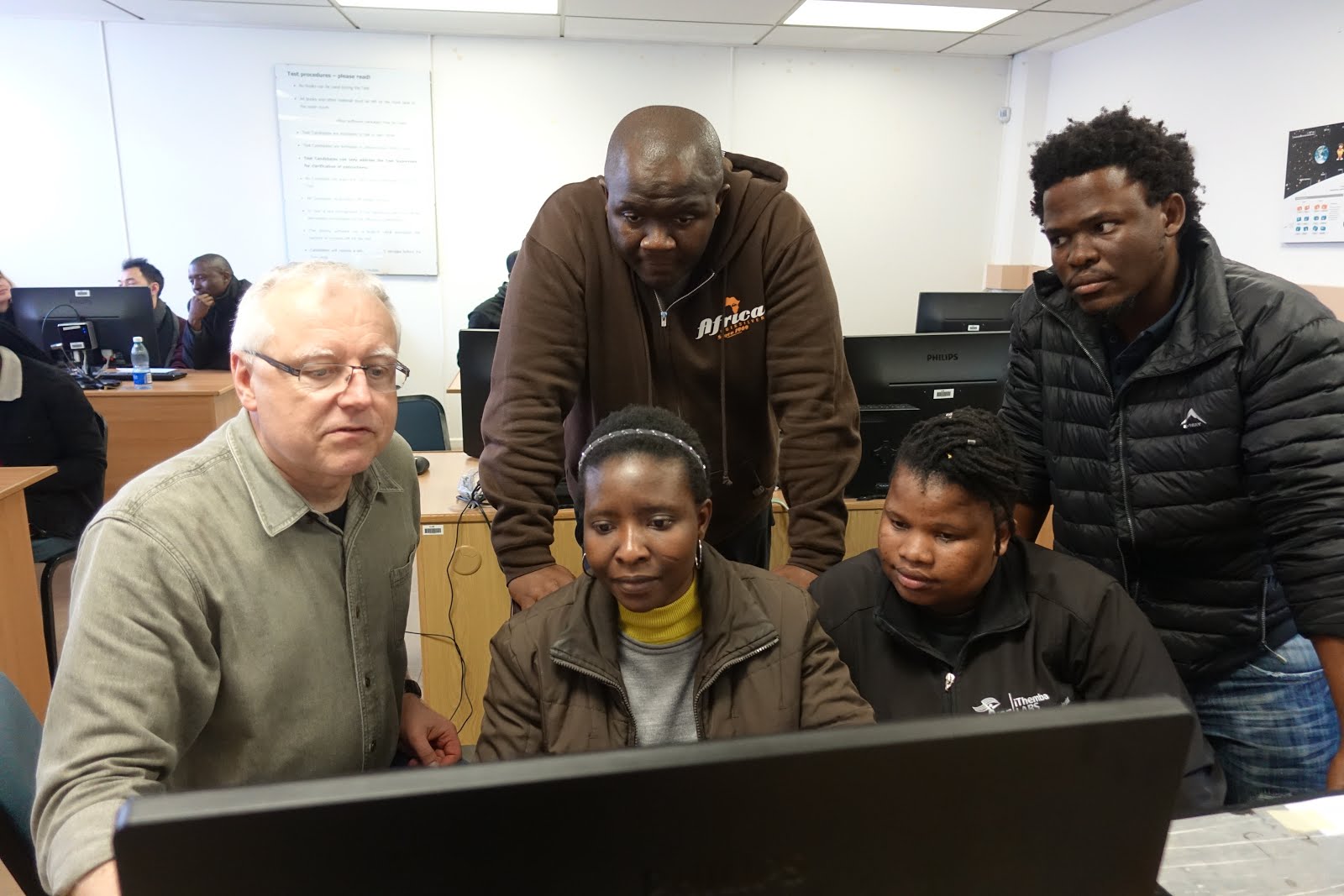
Students went through six exercises. This includes programming FPGAs, comminicating and sending data from an FPGA to a Raspberry Pi, learning to operations with a Raspberry Pi, operating an oscilloscope and measuring time with the available setup.


Great atmosphere where most of the students were able to conclude the program. Some students have shown interest to continue practicing with the setup on Monday and Tuesday after dinner time for which necessary arrangements have been made.


Some enthusiastic students working on the FPGA exercises on Monday after dinner


Raspberry Pis being prepared for the exercises that took place Thursday-Saturday:


The Director of iThemba LABS,  Dr. Faiçal Azaiez came to the lecture venue to greet participants on Monday.


Below are pictures of lecturers in action.  


Below are pictures of the hands-on exercises that took place Thursday-Saturday:

Below is a picture of an EasyPet unit, which is manufactured by CAEN.  For this exercise we used a radioactive source of Na22, a Beta+emitter that provides gamma radiation. These sources were produced by iThemba LABS with an activity of approximately 12 mCi and were sealed in the shape of plastic disks. As an additional precaution keep the sources in plastic zip bags most of the time. Please handle the sources with caution and follow safety rules. 

Four EasyPet units were setup and interfaces with laptop computers. A number of exercises were followed. This included settig up the device, investigating SiPM (silicon photo-multiplier) characteristics with a voltage scan, observing single pulses, identifying the multi-photon spectrum, gamma coincidences and PET imaging. 


Also, having fun (courtesy of Dr. Martin Purschke):


Tuesday, 6 February 2018

Shaking hands with the Minister Research Science and innovation of New Zealand, Dr. Megan Woods at Multicore World 2018

This week Multicore World 2018 takes place in Wellington, New Zealand. This conference is devoted to High Performance Computing and Big Data with emphasis on New Zealand's participation in the SKA:

https://multicore.world

Shook hands with the Honorable Minister Minister Research Science and innovation of New Zealand, Dr. Megan Woods. She is from a new labour government. She pledged to increase the contribution to R&D to the level of 2% in the midterm. She also took some tough questions.


During the second day Hon Clare Curran, Minister of Broadcasting, Communications and Digital Media addressed the conference with a comprehensive presentation on the state of ICT in New Zealand. The minister has ambitious plans to turn ICT into a leading contributor to the GDP in the country. The Minister gave an overview of policies with regards to data access and dissemination in New Zealand. Social aspects related to education and access to data and connectivity are important inputs to policy making.


Very impressed with how down to earth and easy to interact with the Ministers with. The discussion with the audience was candid and open.

Wednesday, 31 January 2018

The Fourth High Energy Particle Physics in South Africa is taking place at the Stellenbosch Institute of Advanced Studies.

The Fourth High Energy Particle Physics in South Africa is taking place at the Stellenbosch Institute of Advanced Studies.

The HEPP workshop is now taking place at STIAS, at Stellenbosch University in the Western Cape. This is the fourth edict in of the HEPP workshop. We have seen a steady increase in the participation of students and senior researchers. Compared to the first edition in 2015 the attendance has increased by about a factor of two. The format of the workshop is such that mornings have lecture style presentations. The afternoons display selected presentations from students or groups of students.

http://hep.wits.ac.za/HEPPW2018.php

Representing iThemba LABS, the host of the SA-CERN consortium, Dr. Mathis Wiedeking, addressed the audience. Dr. Wiedeking touched upon the history of the program and commended the large student participation.


Prof. Jean Cleymans, the Chairman of the SA-CERN consortium was invited to give an introductory lecture on the physics of the Heavy Ion collisions, including an overview highlights of results from the ALICE experiment at CERN.


Below is a group picture taken this morning during the first coffee break:


Below is Dr. Daniel Dercks, from the University of Hamburg, has invited to visit SA to give lectures on the state of the art books in High Energy Physics in the area of phenomenology.


Wednesday, 15 March 2017

Opening session of the ATLAS Tile Calorimeter Upgrade week at iThemba LABS, Cape Town, March 15th 2017

Today we had the opening session of the ATLAS Tile Calorimeter Upgrade week at iThemba LABS, Cape Town. The workshop focuses on questions of instrumentation related to the upgrade of the Tile Calorimeter of the ATLAS detector  at the Large Hadron Collider. Below are photos from the morning session:

The Director of iThemba LABS addresses the audience


Daniel, Dock, the Managing Director of Trax Interconnect (Pty) Ltd gives a presentation with the title  "Capabilities of the South African Electronics Industry"


Dr. Oleg Solovyanov, Project Leader of the Tile Calorimeter gives a colloquium with the title "The Upgrade of the Tile Calorimeter of the ATLAS Detector at the Large Hadron Collider"


The group photo after the open session


Friday, 10 March 2017

Dr. Daniel Adams from the South African Department of Science of Technology visits the High Throughput electronics labs at Wits


Below is a recent picture of members of the Wits HEP group with Dr. Daniel Adams, Chief director at the Department of Science and Technology. Dr. Adams came to the School of Physics to visit the High Throughput electronics lab on March 9th 2017.


Missing in the picture are Marc Sacks, Matthew Spoor, Prof. Alan Cornell, Harshna Jivan. Dingane Hlaluku, Humpry Tlou, Skhathi Mthembu, Kehinde Tomiwa and Yesenia Hernandez are currently in Europe. 

Thursday, 4 August 2016

CEO Sleepout with the Ambassador of Switzerland.

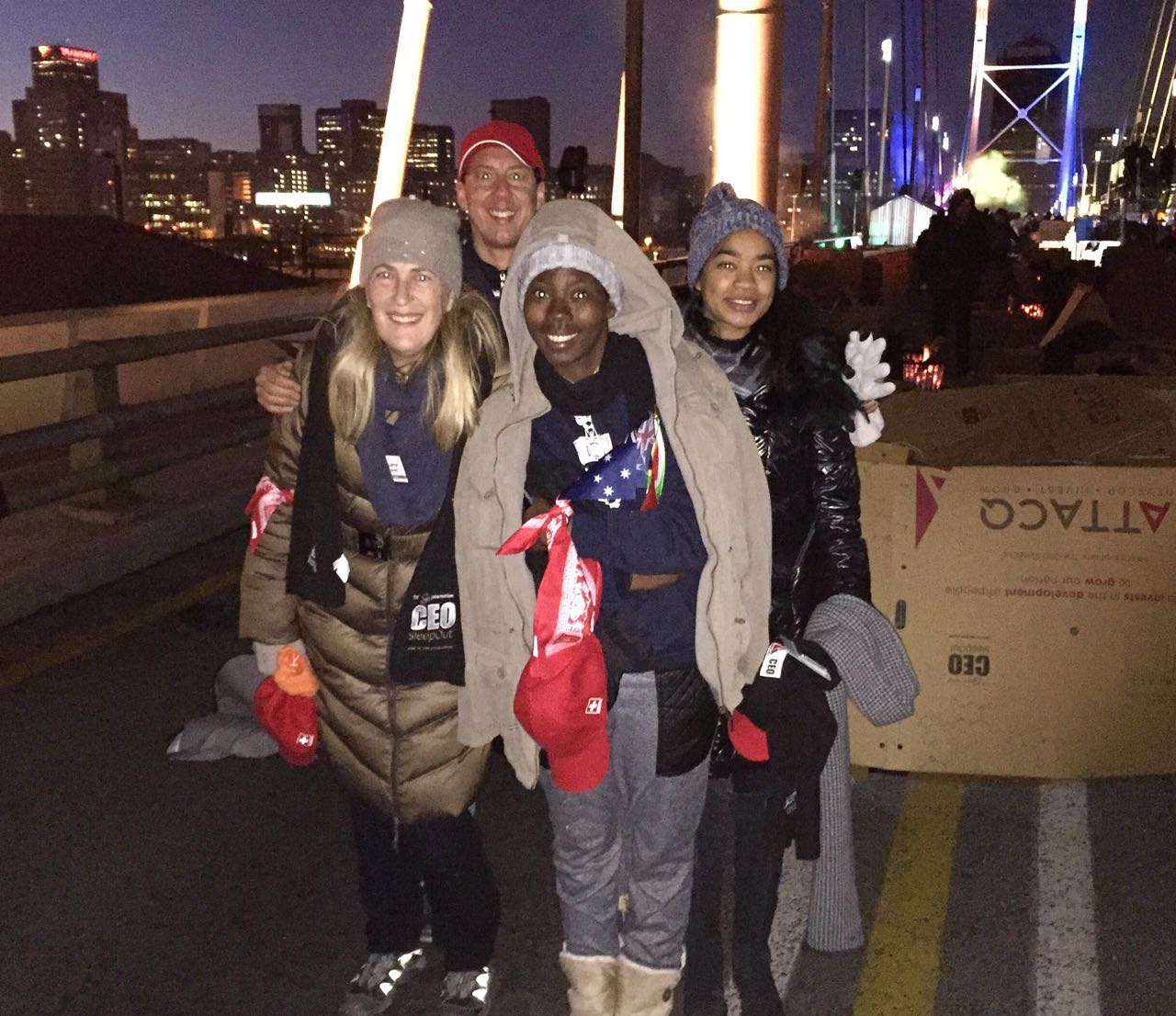
On July 28th 2016, I joined the Ambassador of Switzerland and almost 200 CEO’s at Nelson Mandela Bridge for the #4Leaders4Change CEO Sleepout challenge to spend the night there to fundraise money while gaining empathy for the homeless. The ambassador’s 3 leaders included myself (Joyful Mdhluli), Zoë Petersen and Balz Abplanalp as seen in the picture below.
Embassy of Switzerland's #4Leaders4Change
The #4Leaders4Change CEO Sleepout challenge managed to raise around 19 million by the night of sleepout with the Embassy of Switzerland fundraising over R217 000 to date. We were given a sleeping bag and cardboard boxes to sleep on after having donated a blanket, an informal outfit including shoes and a book. Coffee and soup was available and could be purchased with virtual money we had to work for by either making sandwiches at the kitchen stalls, taking selfies at the photo booth or knitting blankets.

Clothes that were donated upon arrival.
Zoë and I making sandwiches to buy coffee/hot chocolate and soup.
The Ambassador and I after donating our clothes.


I met a lot of CEO’s including the CEO of MTN, KMPG, Liberty Group SA and companies I didn’t even know existed. Among the CEO’s I also met the Premier of Gauteng , the Mayor of Joburg, the Minister of Finance, the ambassador of Canada and the Sleepout organizers.

Ambassador with the CEO of MTN.
Most of the people attempted to sleep in the cold tar road after 12 am and only a few (including myself) stayed up sitting around the fire.

People made tents out of boxes.
Team Switzerland sleeping around 2 am.
After spending 12 hours out in the cold, the Minister of Finance addressed the crowd and Mr Tokyo Sexwale announced that he would be hosting the CEO Sleepout next year on Neslon Mandela Day in Robben Island. 
On our way home at 6 am after spending 12 hours on the bridge.
The experience has taught me to look at homeless people differently. When I see a homeless person now, I don’t see a dirty person who is annoying me for money but someone who spends every night out in the cold with no food or warm clothes. I barely survived the night while wearing 3 jerseys, 3 pairs of pants and a fire to keep me warm. I definitely have empathy for the homeless after spending the night out in the cold.

All the sandwiches made during the night were all given to over a 1000 homeless people together with all the sleeping bags used, clothes and blankets donated.

The homeless collecting their food, sleeping bags and blankets.
It was an honor and a privilege to share this experience with the Ambassador and her team members but I really hope I don't have to do that again any time soon.

More information about the Sleepout


Friday, 17 June 2016

Finally, today we managed to connect all the necessary fibre cables from the Demonstrator module to the Trigger and Data Aquisition System (TDAQ) and took some partial data. In the picture below you will see me (Dingane Hlaluku, Wits University) covering up the barrel modules on top of the table at the Prevessin test beam area.


The Table with which the modules are hooked up can be 360 degrees both clockwise and anticlockwise and also laterally to suit the expert's requirements for data taking. This movement can be achieved in 2 ways viz. manually (see picture below) or remotely using python scripts. We have properly setup the positions which will be required for this test beam into the remote control machine as well today so that there will not be a need for shifters to be in the beam area during data taking.


The picture below shows the position of the beam chamber (Beam focused through that purple rectangular quadrilateral). The beam is kept focused whilst the table with the module is moved around. In the picture below is Andrew Matilton (University of Chicago).


Friday, 10 June 2016


After several  intense weeks of preparation, the demonstrator inside  the Module JINR65 finally makes it to the TB site.  We had   certainly few glitches  but you can see from the picture attached that  we were ready for everything and neither  a  flat tire    could have stopped us today. Moreover, it seems to works pretty well.  A couple of pictures depicting some of the action from today...


Standing next to the truck with the extended barrel module is Dingane Hlaluku in Building 175 where the module was assembled and tested and it is now being taken to the test beam site at Prevessin.


Dingane Hlaluku  (Wits) and Andrew Milton (University of Chicago) closing up the module after inserting the super drawers in Building 175.


Dingane Hlaluku connecting the Single Board Computer (SBC) and the Trigger and Timing Control unit (TTC) for the module's back end electronics. The SBC is responsible for communication between the back end electronics devices which are the TTC, Central Trigger Processing etc. The SBC is also responsible for reading out information.  


Dingane, Irakli and Jallal in building 175 inserting the Super Drawers into the Extended barrel module.