Showing posts with label ATLAS. Show all posts

Tuesday, 18 February 2020

Visiting South African plant for production of electronics for the European Laboratory CERN

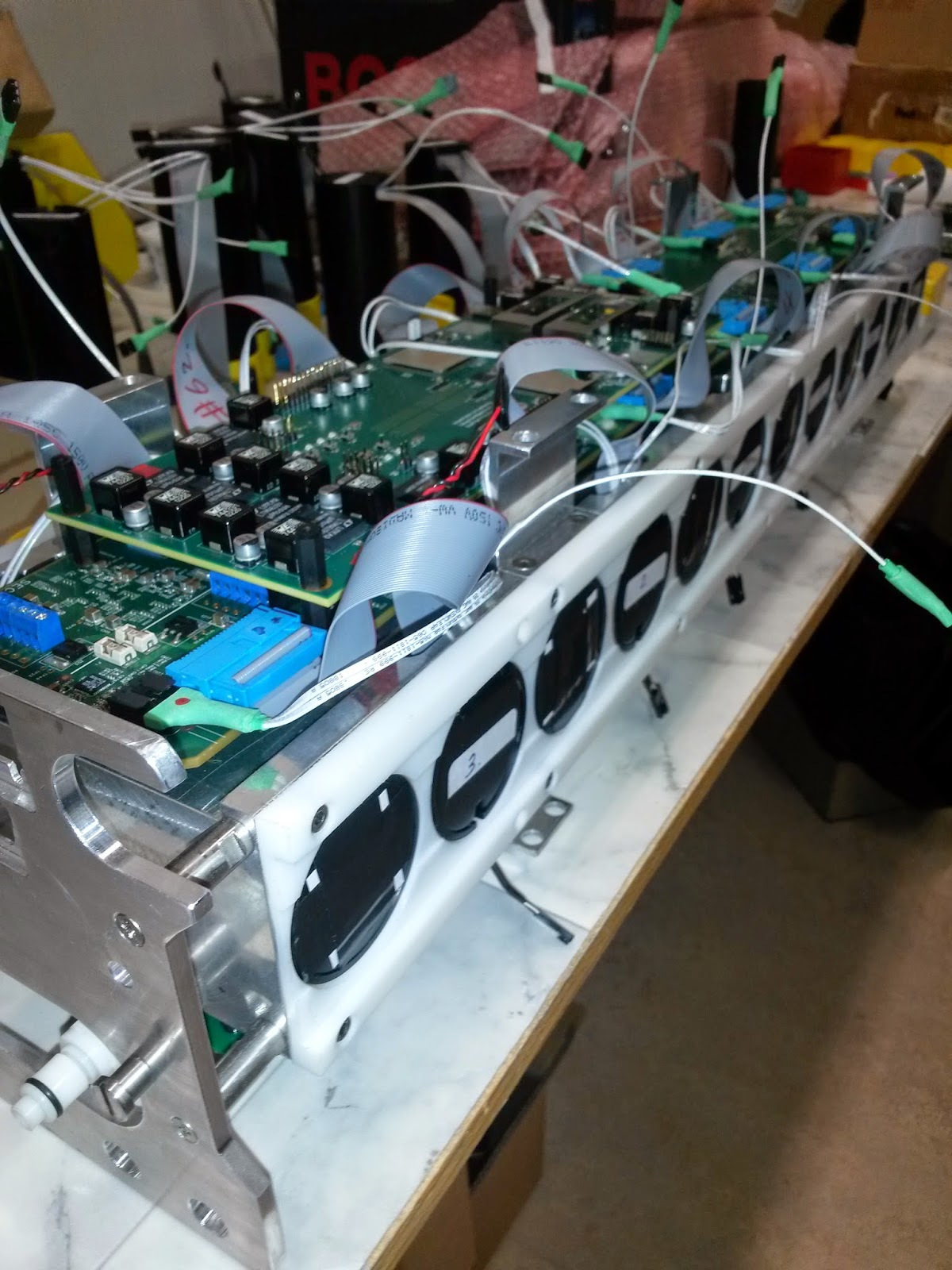
Today a Wits team from the High-throughput electronics laboratory within the Institute for Collider Particle Physics visited Jemstech. This electronics  plant has populated the electronics boards for the first prototype made in South Africa of the Low Voltage Power Supplies (LVPS) for the upgraded Tile Calorimeter of the ATLAS Detector at CERN. The LVPS will power the future on-detector electronics of the Tile Calorimeter that is being designed for the Phase-II upgrade of this detector. South Africa is responsible for the production of over 1000 of these boards, where the PCBs are manufactured in Trax, Cape Town and passed to Jemstech for population.

The Wits team in charge of the South African production is composed of Edward Nkadimeng, Nkhosiphendule Njara, Thabo Lepota, Ryan McKenzie, Charles Sandrock, Roger van Rensburg and Bruce Mellado.

The purpose of the visit is to discuss the production of the second and close-to-final prototype of the LVPS. We discussed quality control issues, details of the bill of materials and other components. Discussed the implementation of Artificial Intelligence in the process of quality control assessment.

Chatted with the Managing Director of Jemstech who was upbeat about his plant. Jemstech delivers commissions for Airbus and will enhance its production capabilities by 600% in July.


Wednesday, 31 January 2018

The Fourth High Energy Particle Physics in South Africa is taking place at the Stellenbosch Institute of Advanced Studies.

The Fourth High Energy Particle Physics in South Africa is taking place at the Stellenbosch Institute of Advanced Studies.

The HEPP workshop is now taking place at STIAS, at Stellenbosch University in the Western Cape. This is the fourth edict in of the HEPP workshop. We have seen a steady increase in the participation of students and senior researchers. Compared to the first edition in 2015 the attendance has increased by about a factor of two. The format of the workshop is such that mornings have lecture style presentations. The afternoons display selected presentations from students or groups of students.

http://hep.wits.ac.za/HEPPW2018.php

Representing iThemba LABS, the host of the SA-CERN consortium, Dr. Mathis Wiedeking, addressed the audience. Dr. Wiedeking touched upon the history of the program and commended the large student participation.


Prof. Jean Cleymans, the Chairman of the SA-CERN consortium was invited to give an introductory lecture on the physics of the Heavy Ion collisions, including an overview highlights of results from the ALICE experiment at CERN.


Below is a group picture taken this morning during the first coffee break:


Below is Dr. Daniel Dercks, from the University of Hamburg, has invited to visit SA to give lectures on the state of the art books in High Energy Physics in the area of phenomenology.


Thursday, 25 September 2014

Prometeo, the next generation test bench for the tile calorimeter upgrade in ATLAS.

During Sep 9.-Sep12, the expert week of the tile calorimeter upgrade, the latest version of Prometeo GUI was published.  After several months designing and consulting from tile calorimeter users, the design has been fixed and working well.

Prometeo is the test bench for the tile calorimeter upgrade in 2022. It is a portable enclosure which is able to certify the tile calorimeter front-end electronics in the maintenance. Prometeo shares the same design of super read-out driver(sROD) and working at the LHC bunch crossing frequency.

The Prometeo GUI is an interface for experts and users to diagnose the front-end electronics. The interface is web and it calls python scripts in the back-end to control the main board in Prometeo. The whole program is running on CERN web service or a mini linux machine inside Prometeo.

The motivation of using the web interface is:
1) Compilation free
2) Compatible of different platforms, PAD, smartphone, or regular PC
3) Robustness in more than 10 years.
4) Compatible to CERN-ROOT software and easy for interface design.

The web interface is much easier than a regular GUI, like Qt/JavaSwing. It is often seen in some router software and it is used well in some HEP tools like MadGraph. The Prometeo GUI combines the web, python, IPbus hardware control together. It is a good mode for a light weight hardware control software.


Friday, 27 June 2014

Helping out with ATLAS Tile Calorimeter Demonstrator

In May this year I moved to CERN in Switzerland for 3 months as part of my studies at University of the Witwatersrand. I have since joined the ATLAS Tile Calorimeter Demonstrator project Group and been helping out where I can. Their aim has been to design, build and install a Hybrid Demonstrator prototype that will replace the aging front-end electronics from 1 to 3 slices of the ATLAS TileCal before RUN 2 begins in 2015. 

The entire LHC is in the process of being upgraded, by 2024 Phase II will begin where the beam energy will be increased to √s = 14 TeV and particle luminosity by a factor of 5. This will potentially address the unsolved mysteries such as dark matter. The demonstrator system needs to be fully compatible with current detector electronics as well as act as a validation for the new read-out architecture (Hybrid Design). Once fully upgraded the data output from the ATLAS TileCal will increase by 200 times to estimated 40 Tb/s!!

Earlier this month CERN had its second TileCal expert week of the year. Experts from around the world came together to help with the build of the first fully assembled Hybrid Demonstrator “Superdraw” prototype. A superdraw is composed 4 separate “minidraws” each that are independent in terms of power, readout and configuration. A total of 45 PMTs, 4 Motherboards, 4 High voltage Cards and 4 Daughter boards were needed to be assembled and connected together. The week was very successful with many new problems being identified as well as confirmation that all the components fitted together correctly and that the entire draw was able to fit in a slice of TileCal. Below are a few photos from that weeks assembly.


Newly built PMTs ready for use.


 Fully Assembled Minidraw.

Demonstrator Superdraw ready for testing.


 Insertion of the Draw into a Test Slice of the TileCal.

Tuesday, 24 June 2014

ATLAS Prometeo System ADC Board


The Analog-to-Digital Converter (ADC) board for the Prometeo system for the Tile Calorimeter of the ATLAS detector has arrived at Wits. The PCB was manufactured at Central Circuits and the mounting took place at Projects Concern in the Gauteng area. This is the last piece of electronics needed to complete the Prometeo system. Oscar Kureba will now test the prototype in conjunction with a FGPA-based board to ensure the functionality of the board is as expected.


Friday, 20 June 2014

Visit to PCB Manufacturing Plant

Robert, Mitch and me visited a plant in Centurion, near Pretoria,  where PCB prototypes have been manufactured for our work with the Prometeo system at CERN. So far we are happy with the interaction and the quality of the PCBs. We will continue working with them. The visit was very instructive in terms of how the process of manufacturing PCBs works and what are the different steps involved in it. It was also very useful in terms of understanding the capabilities and limitations.


Thursday, 12 June 2014

sROD Prototype


We would like to share with you that an important milestone has been fulfilled for the deployment of high-throughput electronics to the ATLAS detector at CERN. Please find attached a photo of the first prototype of a FPGA-based card for the Tile Calorimeter of the ATLAS detector. The next and final prototypes will be manufactured in South Africa after debugging of the prototype in the  picture is finalised. The cards manufactured in South Africa will be used to take data with the ATLAS detector as a part of a demonstrator. 


Friday, 11 April 2014

PCB for ADC board for ATLAS TileCal Prometeo system

Five PCBs for the ADC boards for the ATLAS TileCal Prometeo system manufactured in Johannesburg. The Prometeo system is designed for the upgrade. The first version will be used for the certification of the hybrid demonstrator.

Two PCBs have been sent to be populated. We are aiming at sending the boards to Europe by the end of the month.


Friday, 29 November 2013

Documentation for "Evidence for Higgs Boson Decays to the τ + τ − Final State with the ATLAS Detector"

ATLAS has just released the documentation for the evidence for the decay H->tautau. The documentation can be found at:

http://cds.cern.ch/record/1632191/files/ATLAS-CONF-2013-108.pdf

The Wits group, some of its members and close collaborators have been involved in this search for a number of years.

Tuesday, 26 November 2013

Improving Higgs plus Jets analyses through Fox-Wolfram Moments

The preprint with the title "Improving Higgs plus Jets analyses through Fox-Wolfram Moments" has appeared in the archive today. Among other things one can see a discussion on how the jet veto can be replaced by a moment pertaining to extra jet radiation.

The abstract can be found below:

"It is well known that understanding the structure of jet radiation can significantly improve Higgs analyses. Using Fox-Wolfram moments we systematically study the geometric patterns of additional jets in weak boson fusion Higgs production with a decay to photons. First, we find a significant improvement with respect to the standard analysis based on an analysis of the tagging jet correlations. In addition, we show that replacing a jet veto by a Fox-Wolfram moment analysis of the extra jet radiation almost doubles the signal-to-background ratio. Finally, we show that this improvement can also be achieved based on a modified definition of the Fox-Wolfram moments which avoids introducing a new physical scale below the factorization scale. This modification can reduce the impact of theory uncertainties on the Higgs rate and couplings measurements."

The link to the preprint is:

http://arxiv.org/abs/1311.5891

As Tilman likes to say

Aloha


Wednesday, 20 November 2013

Assembling scintillator counters for the TileCal

Today the assembly of the gap scintillators with Bicron plastics started in  building 175 today. The plastics were produced and machined by Bicron.

Below is a photo of Bicron plastics before being placed in the aluminum case:


Below is a photo of the assembly table. To the left is Charles Sandrock, head technician of the Wits School of Physics. His trip is supported by the SA-CERN consortium.


Friday, 15 November 2013

Prototype of LED board for the front-end electronics test-bench of the ATLAS TileCal

The first certified prototype of the LED board for the front-end electronics the new test bench of the ATLAS TileCal is now available at Wits.

Expect next and final iteration next week and delivery to CERN early December.


Thursday, 14 November 2013

Conclusions from first Back-end Front-end integration excercise


The following is the outcome of the first Back-end Front-end integration exercise:
  • The communication between Daughterboard (front-end) and the Super Read-out Driver, sROD, emulator (front-end) has been successfully tested.
  • Achieved upstream and downstream flow.
  • Two different platforms were used as sROD emulator: Xilinx Virtex 7 and Xilinx Kintex 7. Obtained satisfactory results with both evaluation boards.
  • An overnight test has been performed to spot potential transmission errors. No error was identified after 14 hours. 

Tests have been performed between an external PC and the readout chain using an IP bus:
  • An IP bus interface has been integrated in the design of the sROD emulator.
  • This facilitates easy access to hardware registers in the sROD emulator over ethernet. 
  • Different communication tests have been performed successfully using the IP bus interface, allowing to use the external PC to read and write registers in the sROD emulator. 


Tests communication between the Daughterboard and the Mainboard:
  • Commands and data words have been transmitted from the sROD emulator to the daughterboard using the IPbus interface.
  • The Daughterboard processes and transmits the commands and data to the Mainboard.
  • This test was not completely successful. The daughterboard reacted to the commands received over IPbus, but not in the expected way.
  • Bug probably in the state machine that decodes the command into specific actions for the Mainboard. 

Next integration session will take place in December at CERN.

To the right, Pablo Moreno, from Wits.