Nicola Mawson, from ITWeb has written a nice appraisal of the importance of the role of the South Africa - CERN program and its benefits to the country.
http://www.itweb.co.za/index.php?option=com_content&view=article&id=70626:SA-reaps-CERN-rewards
SA's involvement with the Large Hadron Collider (LHC), in Switzerland, is paying dividends as the country embarks on new electronics and physics projects, and benefits from knowledge gained at the European Organisation for Nuclear Research (CERN).
Thanks to collaboration on the project – the £2.6 billion "Big Bang" particle accelerator and the globe's largest experiment – South African universities are developing technology in fast electronics, supercomputing and plastics.
The LHC at CERN led to the discovery, in 2012, of what has become accepted as the elusive Higgs boson. This discovery is anticipated to catapult physics into a new era, as it will be able to probe previously untouched areas, such as dark matter and dark energy.
The Higgs particle – or boson – is named after Peter Higgs, who was one of six authors who theorised about the existence of the particle in the 1960s. It is commonly called the "God Particle", after the title of Nobel physicist Leon Lederman's "The God Particle: If the Universe Is the Answer, What Is the Question?", according to Wikipedia.
Locally, about 70 South Africans are involved in the global project and, while the team is small in comparison to those from other countries, there are substantial benefits coming out of its involvement.
Four universities are participating in the programme: the University of the Witwatersrand (Wits), University of Cape Town (UCT), the University of Johannesburg, and the University of KwaZulu-Natal.
Tom Dietel, a lecturer at UCT, says CERN is a flagship project and is expected to spark interest in science and physics.
Bruce Mellado, an associate professor at Wits' school of physics, says the tertiary institution is involved with projects to develop fast electronics, a new form of plastic, and create a cheap alternative for high-throughput supercomputing.
Mellado explains South Africans have been given the opportunity to tap into CERN's infrastructure at very little cost to the country. He says the country has been "given the benefit of a huge facility without having to pay hundreds of billions for it".
Professor Jean Cleymans, from the UCT's physics department, explains SA's involvement – mostly with the
Atlas experiment – is a national project and is not specifically linked to any university. SA is also making contributions to the
Alice and
Isolde projects, he says. "It's important to have a first step in there."
Cleymans says SA's involvement gives young physicists access to technology, software being developed and knowledge.
Cleymans says "far from being limited to Europe", the project is a worldwide project to contribute to advances at CERN. SA's first step happened in 1992, when it signed its first agreement of interest, he notes.
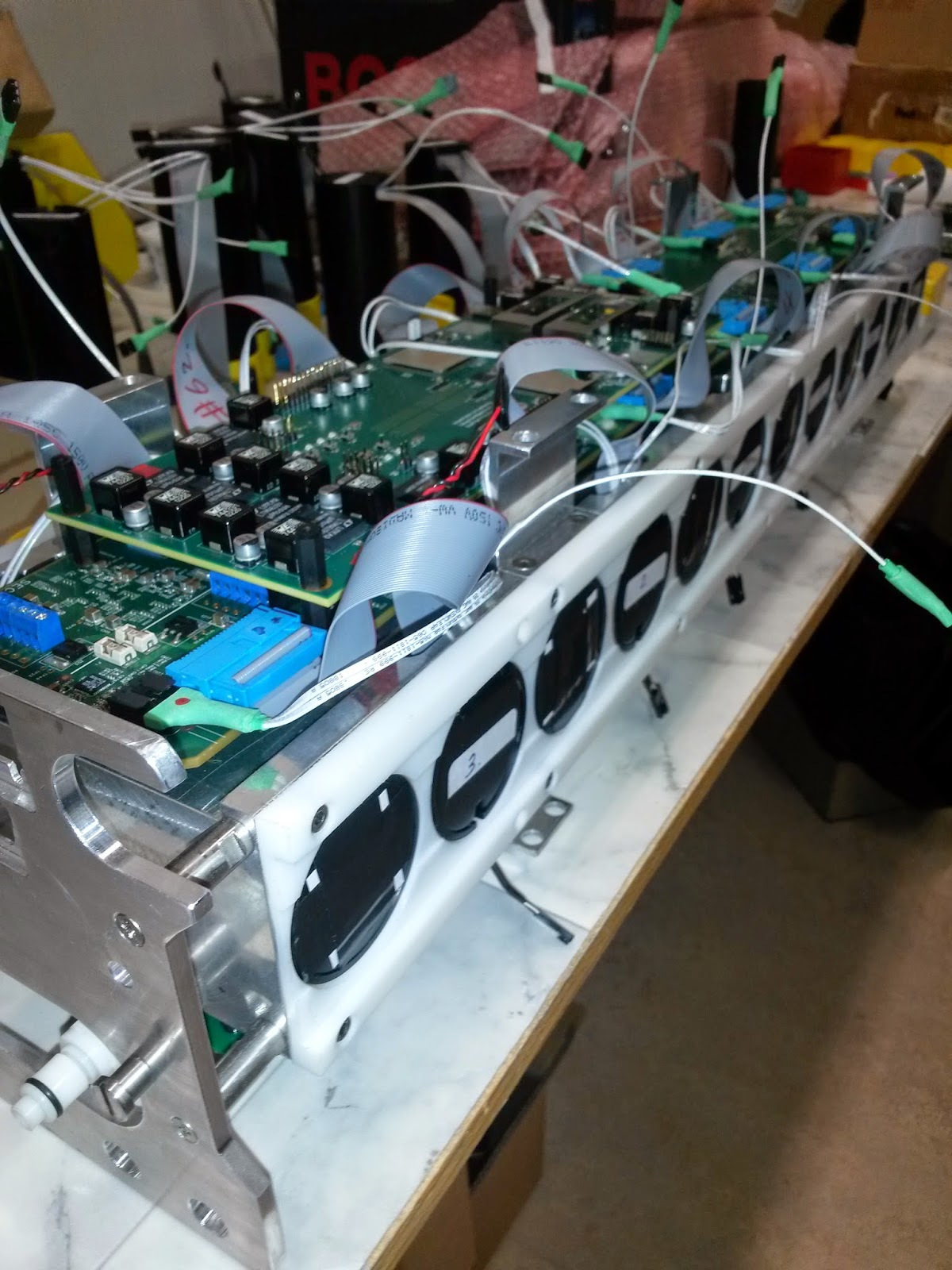
Mellado explains one of the university's initiatives – named
sRod – is a faster electronics board, which will be able to process much more data at faster rates. The board, being developed through collaboration in Europe and SA, is being made in conjunction with SA's Square Kilometre Array (SKA) team.
The multibillion-rand telescope
project, hosted by SA, Australia and New Zealand, will collect a staggering amount of data as it probes the universe: the data collected by the SKA in a single day would take nearly two million years to play back on an iPod.
Mellado says the prototype board should be in production locally before winter, which will be a "major milestone for SA". He explains there are increasingly large amounts of data to be analysed, but the price for the hardware is currently a "showstopper".
Being able to get university-made technology commercialised will drop the cost and allow SA's technology industry to develop further, says Mellado. "That's the key to further development."
Wits is also developing a supercomputer under its
Mass Affordable Computing project, which Mellado says takes the technology from smartphones and uses it for generic applications such as telecoms and computing. This programme will also be used to aid the SKA's data processing needs. "We can proudly say that we are doing it here."
Such projects are critical to SA's science, says Mellado. "Everything now depends on data processing."
The university is also developing – in collaboration with Sasol –
plastic scintillators, with a prototype due in a year or two. Mellado says this material will allow the absorption of light.
The South African consortium launched in 2008 and a few ministerial delegations have visited CERN, says Cleymans. SA's contribution is hosted by iThemba Laboratories, which is a national open laboratory, he adds.
The Department of Science and Technology is funding SA's contribution, says Cleymans, adding that CERN is the first project that has seen South African physics departments team up to collaborate.
CERN is currently temporarily offline in a bid to increase its capacity and explore unknown aspects of physics. In the meantime, South African scientists are helping analyse the data it has collected and are aiding with maintenance.
The experiment will run until 2030 and will be upgraded to 10 times its initial design specification, with the ability to collect 100 times more data.